Over the past decade, many enterprises have assembled their MarTech stacks along the lines of frameworks set out by the major consultancies. McKinsey's 2017 paper The Heartbeat of Modern Marketing: Data Activation & Personalization introduced a four-pillar architecture — data foundation, decisioning, design, distribution — with a representative customer named Jane who shops for yoga pants and is moved by a 15 percent one-day discount on workout equipment. The paper promised a 15 to 20 percent sales lift. BCG's parallel guidance has positioned the CMO as a “chief growth architect,” presiding over the same data inputs and measurement models. Bain's surveys have quietly tracked the resulting build-out: roughly fifteen thousand MarTech tools by 2025, billions of dollars deployed against the four-pillar logic.
Most of it was right at the time.
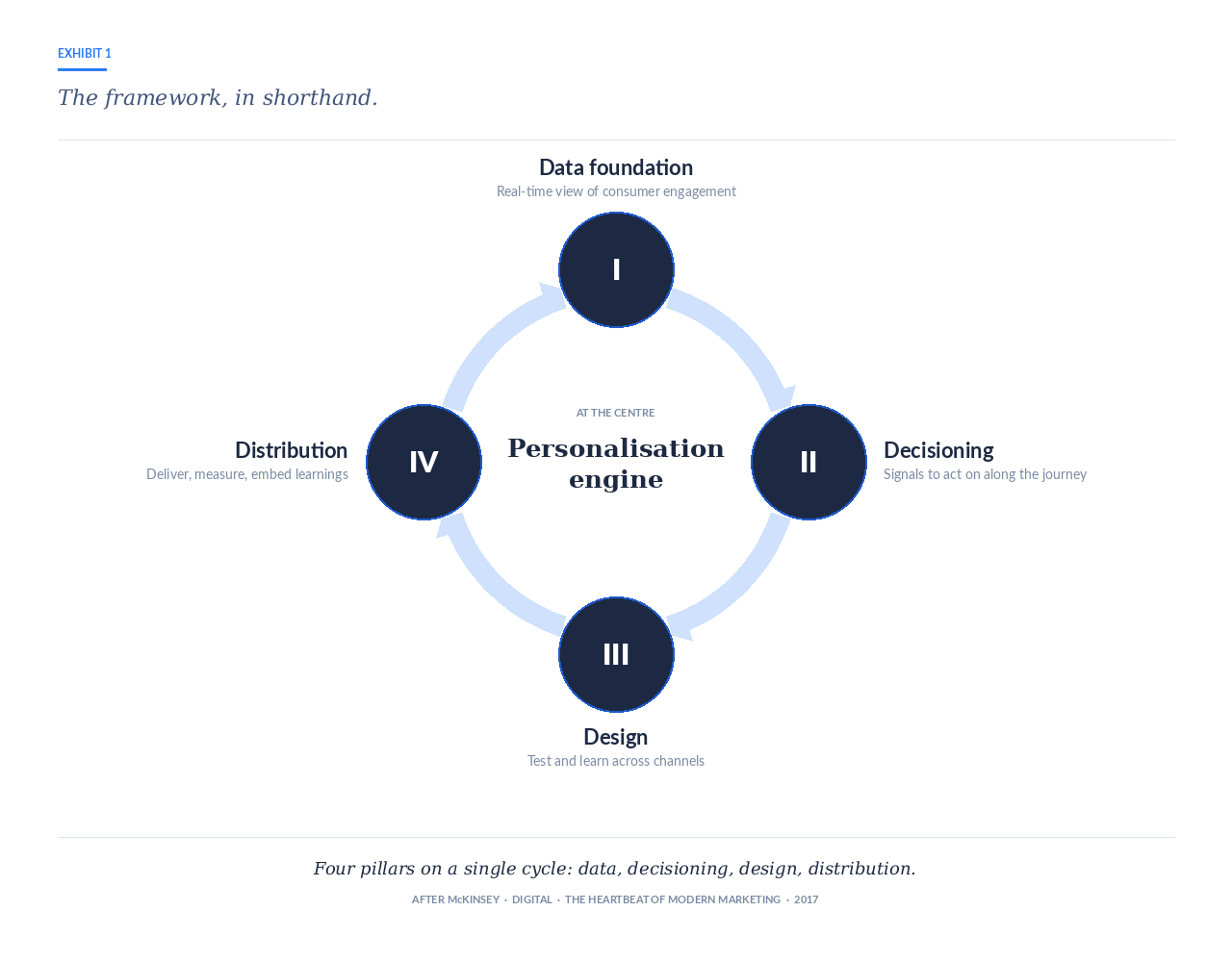
Many of the CDPs, journey-optimisation platforms, content-management systems and decisioning engines installed in the last eight years were sold against the four-pillar framing the major consultancies helped popularise. The wave of consolidation, the rise of the marketing-technology stack as a recognised P&L line, the war-room operating model, the case for cross-functional ownership of the customer journey — much of this began life in papers like that one, and the engagements that followed.
What the framework could not see was the audience.
What the framework could not see
Jane is still there. But increasingly Jane has counsel. Before she opens the brand's site, an agent acting on her behalf has read the spec sheet, ranked the competitors, looked for the line in the small print Jane might have missed, and brought back a one-paragraph summary. The agent does not get tired. It does not get charmed by a hero image. It does not care about the email subject line your A/B test optimised. It reads what is verifiable.
This is not the same problem the 2017 paper was solving. It is a structurally different problem.
The consulting cohort itself is now acknowledging the stack has underperformed. McKinsey's October 2025 paper Rewiring Martech: From Cost Centre to Growth Engine concedes that the 2017 promise is largely unfulfilled, and notes that the MarTech market has grown to roughly fifteen thousand vendors. Bain's December 2025 brief Too Much Marketing Technology, Too Little Impact reports that 57 percent of marketers added between one and five new tools in 2024 alone, and that 66 percent of survey respondents cannot measure the effect of these systems on the business. The single finding from McKinsey's recent paper that stayed with us was this:
Not one of the fifty senior marketing leaders the firm interviewed at Fortune 500 companies could clearly articulate the ROI of their organisation's investment in martech.
The proposed fixes share a common shape. McKinsey proposes agentic orchestration — intelligent agents managing the data, decisioning, design and distribution layers on the brand side. Bain proposes a primary platform anchored by bespoke best-of-breed tools, with active integration and AI-powered customisation. BCG proposes recasting the CMO as a “chief growth architect” who designs MarTech data flows that connect demand signals to an integrated growth agenda.
All three fixes are necessary. None of them are sufficient. They all assume the audience is a human at the end of the brand's pipeline. The customer's agent does not appear in any of the diagrams.
What comes next
This is the gap A Moment to Think — the volume Appice has just published — names directly. Twenty-one essays on what marketing becomes when the audience is another machine, briefed by your customer, paid to be sceptical on their behalf. The argument is not a critique of agentic marketing. It is an argument that the next round of CMO procurement won't ask “which orchestration platform?” or “which primary MarTech anchor?” It will ask: is the answer machine-readable, signed, exportable, and verifiable at the moment of decision?
Three things follow
Brand becomes provenance. The agent does not weigh tone, story, or surprise the way a human does. It weighs whether a claim is signed, whether a price is structured, whether eligibility is determined when the agent queries (not when the human applies), and whether the audit trail is exportable to the customer's record. The brand's job stops being persuasion. It starts being credible answerable substance.
Measurement becomes audit. Click-through rate measured the human who scrolled. It does not measure an agent that does not click. The next generation of measurement is the audit trail produced as a by-product of every decision — the same artefact a regulator already requires. Marketing measurement and risk reporting converge.
Procurement criteria change. The platforms built for the audience that was can be invisible to the audience that is. The platforms designed for both can answer four questions: do they expose claims machine-readably, do they negotiate at the moment of decision, do they produce reasoning as audit trail, do they price for outcomes verifiable by the customer's agent? In the agent era, these stop being preferences and become entry criteria.
A Moment to Think walks through what each of these means for brand, measurement, channel mix and the organisation. It is free, available at appice.ai/a-moment-to-think.
The frameworks that built the stack were right about almost everything except who would be reading. That is now the question worth re-asking inside every marketing organisation. Most of the answer is still in front of us.
Continue the argument in the follow-up: Marketing's New Role: Beyond Matching — on what's left for the brand once the agent does the matching.