The argument from this page two weeks ago: when the audience has an agent, the matching marketing spent a century approximating happens directly — agent to agent, instantly, at almost no cost.
The harder question lands in the days after. If the agent takes matching, what's left for the brand to actually do?
Three things, at least for now. None is matching. All sit at the limit of what agents currently do. Demand creation. The agent-facing surface. The relationship after the match.
Demand creation
Theodore Levitt named the work in 1960. Marketing's deeper job, beyond matching, was to invent the want. Levitt's argument: companies fail when they confuse what they sell with what they're for.
The categories that defined consumer life in any given decade did not arrive through matching. They arrived through invention. Someone named a need the customer hadn't named, and over time the need became real. The iPhone. Airbnb. Tesla. Slack. ChatGPT. None polled well in advance. Each created the category it competes in.
Agents do not yet do this work. They are formidable at matching what already exists. What an agent cannot yet do is originate the category in the first place. Invention requires taste, foresight, and courage — the willingness to invest in a category that doesn't yet have customers. These are still human jobs.
For the brand, the practical implication is sharp. Budget that went to optimisation now competes with budget for invention. The brand that finds the next category will own it before the agent has the data to match into it.
Agents match what exists. Marketing makes what doesn't.
→ The longer argument: Marketing Was a Workaround
The agent-facing surface
For two decades the brand spent its budget designing a customer-facing surface for humans. The next decade goes to designing one for agents.
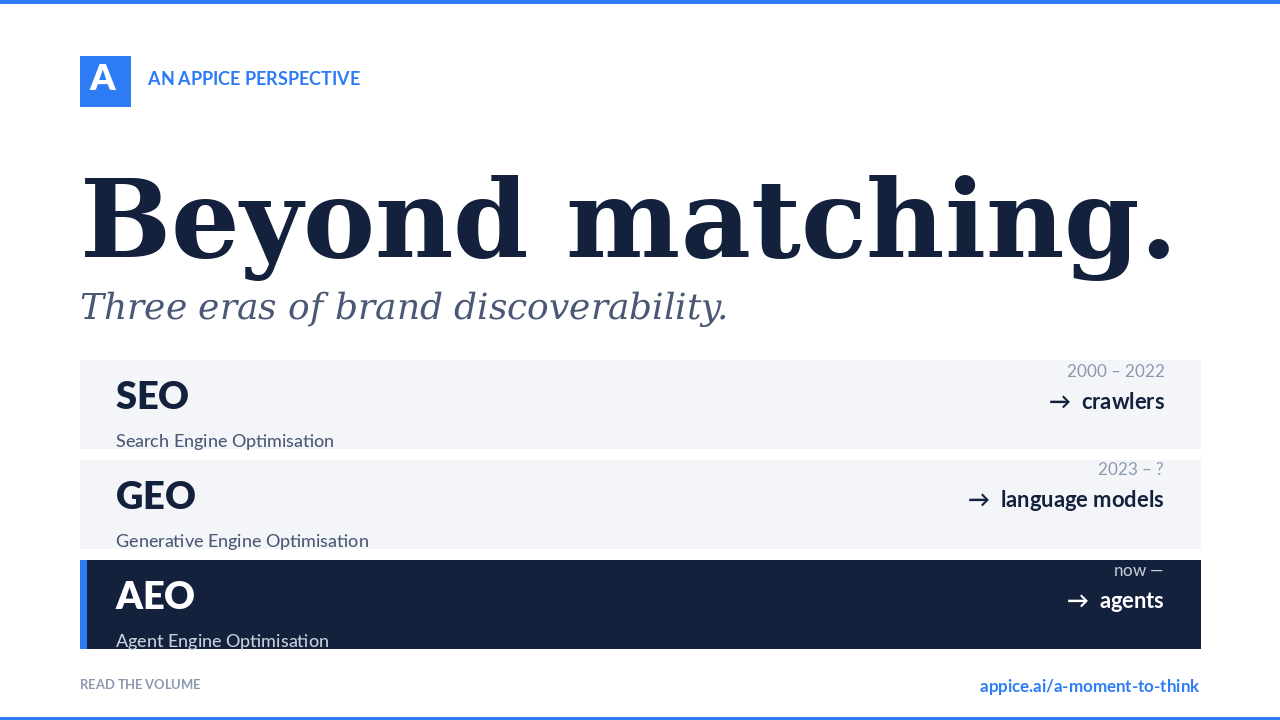
For most of those decades, the work of being discoverable had a name: SEO. Brands invested heavily in being findable by Google when humans searched. Then 2023 brought generative engines. LLMs began answering user queries directly rather than handing back ten blue links. GEO — generative engine optimisation — became the next discipline. The question shifted: not “does Google rank you” but “does the LLM mention you when answering.”
Now the work is shifting again. AEO — agent engine optimisation — is about being selected by the agent acting on the customer's behalf. The agent doesn't search. It doesn't summarise. It picks.
Each phase required brands to publish their identity to a different reader. SEO published to crawlers. GEO publishes to language models. AEO publishes to agents with budget, preferences, memory, and accountability for outcomes.
The brand that stopped at SEO is already invisible in GEO. The brand that stops at GEO will be invisible in AEO.
An agent doesn't visit a homepage, watch a commercial, or click an email. The agent reads a brand the way a database reads a row — it ingests structured data, evaluates verifiable claims, and compares specifications. Logos, celebrities, and awards don't carry weight in an agent's evaluation. Verifiable evidence does — third-party audits, on-chain credentials, signed assertions that can be checked.
The brand's website was for humans. The brand's API is for agents. The next decade is about designing the API.
What couldn't be machine-read couldn't be matched.
The relationship after the match
An agent doesn't have an attention problem. Once it has matched a customer to a brand, the brand has only what happens next.
In the agentic world, the funnel never ends. The agent records every aspect of the post-purchase experience — the delivery, the support quality, the product against its specifications, the customer's satisfaction. None of this is hidden the way it was hidden from the brand's acquisition team. The agent watches.
The agent has memory, and the memory is granular. Which brands met their commitments. Which had responsive support. Which products matched their specifications. That memory shapes every future comparison.
For three decades the discipline had a name: CRM. It assumed the relationship was brand-to-human, reachable through email, phone, app, and loyalty offer. In the agentic world, the brand's relationship is no longer just with the customer. It is also with the customer's agent, which mediates, compares, and remembers. Call it Digital RM. The brands that experiment now will own the playbook the vendors later sell back to the slower ones.
The brand that disappoints the agent gets quietly unmatched. There is no exit interview. No discount offer can win back the customer the agent has already moved on from. The agent picks once. The brand earns the renewal.
The agent's memory is the brand's accountability.
The brand's new job
Look at the three jobs side by side and a pattern emerges. The brand creates — invents demand agents cannot yet originate. The brand signals — publishes specifications agents need but cannot generate. The brand sustains — earns trust through post-match performance agents track but cannot manufacture.
This is a more honest brand function. Closer to what brands have always claimed to do. Further from what consumed most of their budget over the past decade — paid acquisition, segmentation, retargeting, attribution modelling. All of these were the work of approximating the match that agents now do directly.
The brand's job hasn't disappeared. It has inverted.
Where the brand used to persuade humans, it now equips agents. Where it used to broadcast, it now publishes specifications. Where it used to chase the next campaign, it now invests in what the next campaign can't fake.
The work is harder. The accountability is sharper. The brand survives. Its shape changes.
The longer argument — and twenty other essays on what survives, what doesn't, and what marketing becomes — is in A Moment to Think.