Sovereignty stopped being a policy question. It became an architecture question.
That's the argument. Everything else is why.
The last twelve months broke a decade-long consensus in enterprise IT. Cloud-first is still the official position at almost every large enterprise. But quietly, in the risk registers CIOs actually maintain, the position has changed.
The trigger wasn't a data breach. It was the arrival of the customer's agent.
→ The category shift: Marketing's New Role: Beyond Matching
Here's what broke. Not who sets policy. That's still the enterprise, on paper. What broke is the gap between accountability and control. The enterprise stays accountable to its regulator for what happens to a customer. But the enterprise no longer runs all the systems the answer depends on. Every SaaS vendor holding a piece of the customer record is now a subpoena target, a breach target, a policy-drift target. Under laws like the US CLOUD Act, US authorities can compel a US-based vendor to disclose customer data regardless of where it physically sits or what the DPA says. The customer's agent multiplies the query volume against every vendor API by orders of magnitude, in patterns the vendor's UI-era access controls were never designed for. Accountability sits in one place. Control got scattered.
Sovereignty stopped being about paperwork
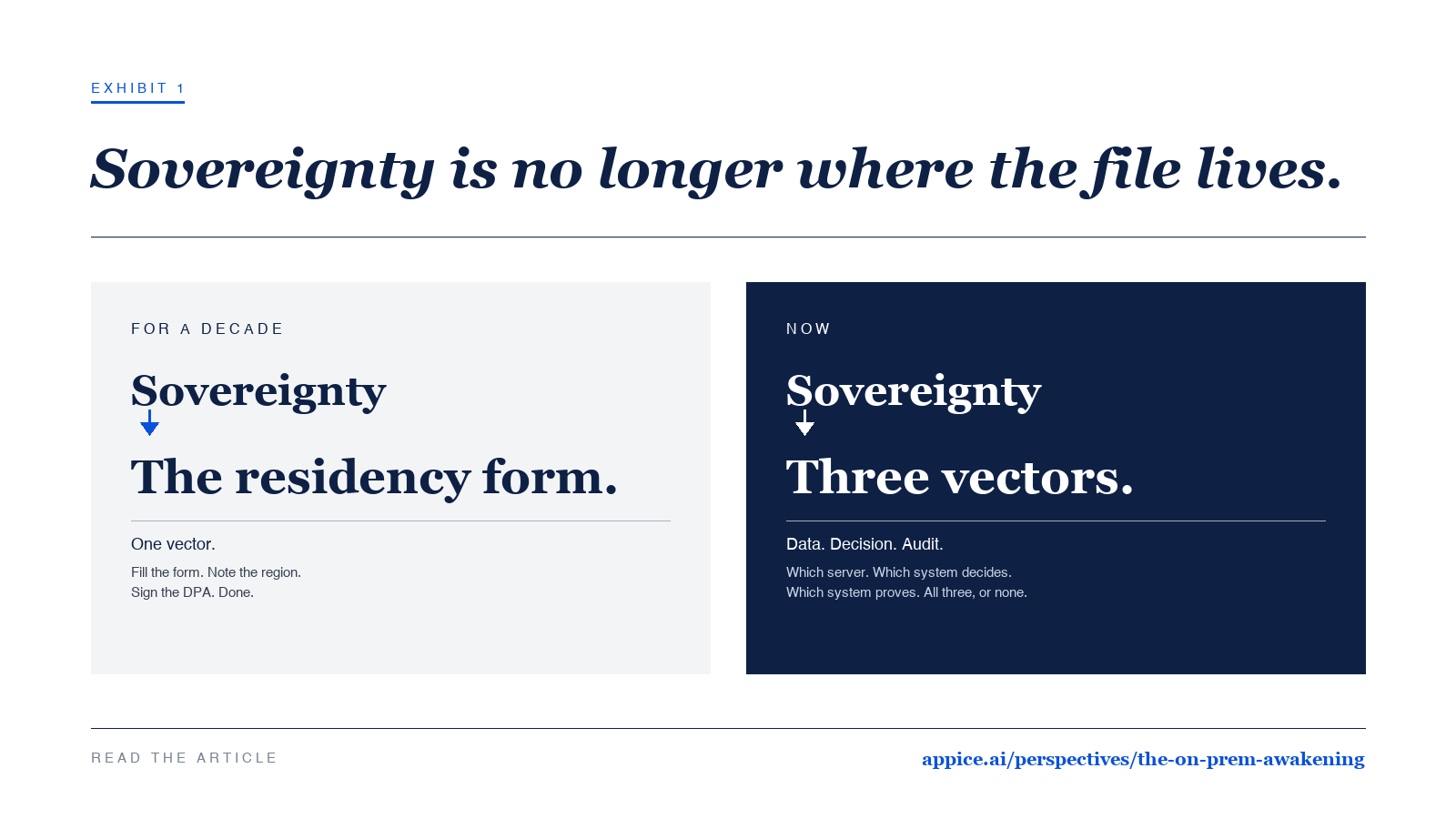
For a decade, sovereignty meant one thing. The customer data has to live in-country, per a specific paragraph in the RBI Master Directions or the DPDP Act or a SAMA circular. Fill in the residency form. Note the region in the AWS config. Sign the DPA. Done.
That definition is over.
The new definition has three vectors. Only one of them is about where the file physically lives.
Data sovereignty. Which server holds the record. Necessary, not sufficient.
Decision sovereignty. Which system decides what happens to the record, and whether the enterprise or the vendor controls that system. If the decisioning engine, the segmentation logic, and the customer 360 all live in a vendor's cloud, the enterprise has ceded this. Regardless of what the residency form claims.
Audit sovereignty. Which system can prove, to the regulator or the board, what was actually done and why. SaaS platforms produce audit trails for the vendor's convenience. Not for the regulator's query.
You can't claim sovereignty on the first vector alone. The customer's agent doesn't care where the data is stored. It cares who controlled the decision.
The tailwind
Cloud spending in India's Tier-1 banks is up roughly 40 percent year-over-year. Customer-facing outcomes are flat. That was an uncomfortable board conversation before the agent arrived.
Regulators moved in the same direction. DPDP Act. RBI outsourcing directions. SAMA and CBUAE national cloud policies. Vision 2030 naming sovereign cloud as strategic infrastructure. MAS tightening third-party risk. Indonesia's PDP Law, Vietnam's Decree 53. Every jurisdiction converging on the same principle. The right workload in the right place. Cloud for elastic compute, model training, disaster recovery. On-prem or private cloud for the decisioning engine, the customer data platform, the audit trail. The parts of the stack that touch a customer signal live inside the perimeter.
That isn't "cloud is dead." That's cloud unbundled from customer data.
An existence proof
The pattern isn't theoretical. India built it at national scale.
UPI processed 18.4 billion transactions in July 2026. Aadhaar authenticates over 100 million times a day. Both run on Indian rails, under Indian law, auditable by the Indian regulator, at latencies that outperform every non-domestic equivalent. Neither depends on a foreign vendor's cloud.
Sovereign infrastructure and world-class performance aren't opposed. When the architecture is right, they compound.
The same pattern is now being asked of enterprise decisioning.
What breaks, what survives
Any vendor whose architecture requires their SaaS to host your customer data breaks. Which is most of MarTech.
The pitch is unchanged. "You don't have to run it. We handle everything." That was strength ten years ago. It's now the opposite. If the vendor handles everything, the vendor controls decision sovereignty. The CIO's answer to the regulator becomes "we outsourced it, ask them." That answer won't fly.
What survives: platforms architected to run inside the customer's perimeter from day one. On-premise. Private cloud. Hybrid. Vendors who can't deploy locally get eliminated in the RFP shortlist. The next-generation buyer is the CIO who can say to the board, credibly. "The customer's data never left our building. Every decision is logged. Every action is auditable. We can prove it. Because we ran the whole loop ourselves."
What the CIO has to answer
Three questions any decisioning platform selection should now answer, without deflection.
Where does the customer data physically reside, and who else has read access?
Which system decides what happens to it, and does the enterprise or the vendor control that system?
Can the enterprise prove, in real time, not next quarter, what decision was made, why, and by which model version?
If any answer runs through a vendor's server outside the enterprise's control, the CIO hasn't achieved sovereignty. The CIO has achieved documented dependency.
The reframe
For a decade the CIO defended cloud spend by pointing at velocity, elasticity, and vendor capability. Those arguments still hold, for the workloads where they hold. They stop holding at the moment a customer's agent can read the vendor's API.
Sovereignty is what defends the seat now. Not sovereignty as paperwork. Sovereignty as an architectural choice about which system decides, which system records, and which perimeter contains the customer's data.
The CIOs who understand this move fast. The ones who don't spend the next two years explaining to a regulator's agent why they didn't.
Sovereignty stopped being a policy question. It became an architecture question.
The longer body of work, twenty-one essays on what marketing becomes in the agent era, is in A Moment to Think.