The CFO isn't marketing's enemy. The CFO is the audience marketing forgot how to write for.
That's the argument. Everything else is why.
The argument from this page two weeks ago: three jobs survive for the brand once the customer's agent takes matching — demand creation, the agent-facing surface, the relationship after the match. Two of those are what marketers were always paid to do. The third didn't exist a year ago.
The question that follows isn't rhetorical. It's a budget line. This year, every board budget conversation about marketing is a version of the same negotiation. The CMO asks for the budget to rebuild for the latest technology. The CFO asks the question they've asked for a decade: prove the line to enterprise value.
The CMO can't. The rebuild stalls.
This isn't a CFO problem. It's a marketing problem.
The trust budget
Steelman the CFO first. The case is fair.
Thirty years of MarTech spend has struggled to prove the line from marketing to enterprise value. Bain's December 2025 brief Too Much Marketing Technology, Too Little Impact found that 66 percent of surveyed marketers can't measure the effect of their systems on the business. That isn't a marketing failure. It's a marketing admission. And the CFO read it before the CMO did.
Marketing spent the last decade proving attribution. It should have spent it proving value.
The result, in every boardroom, is a CFO who doesn't fund marketing rebuilds on faith. Somewhere between 2018 and 2024, the CFO stopped asking for the evidence marketing kept promising.
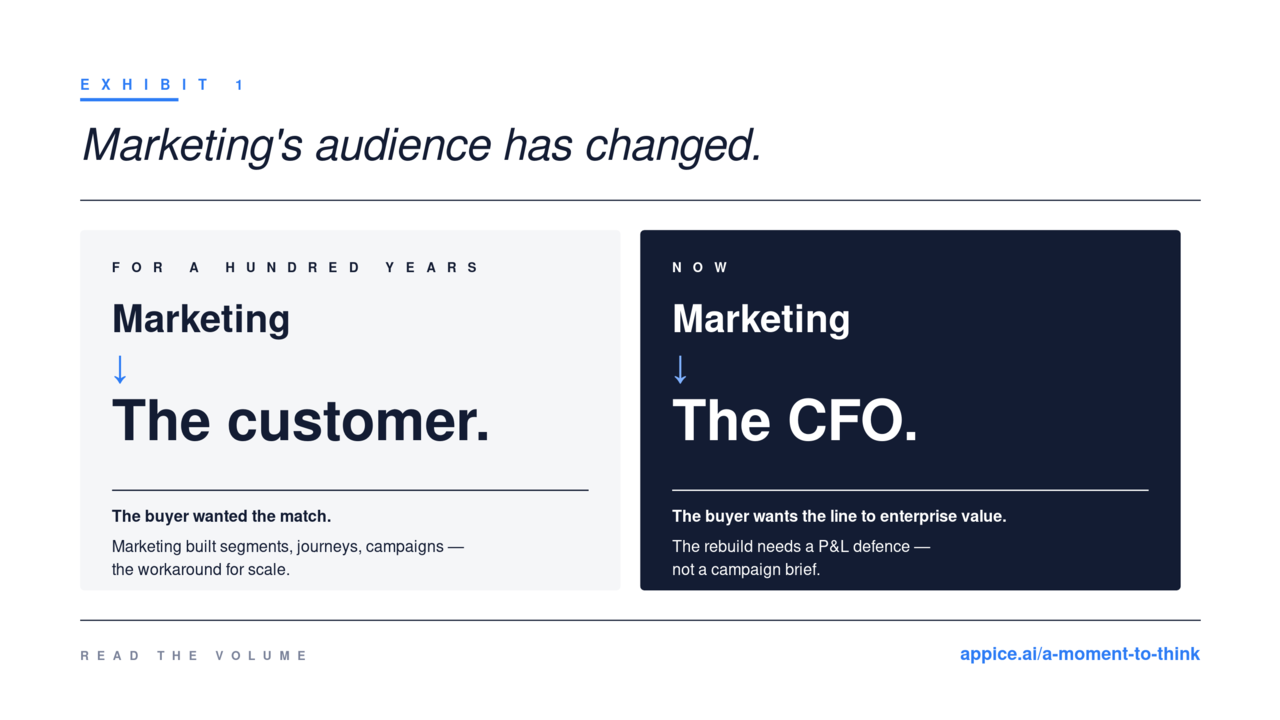
The ask to fund the rebuild of a function whose core job just got automated by the customer's agent lands into that environment. Someone else does the matching now. Instantly. At almost no cost. If the budget request looks like the last one — segments, journeys, campaigns, personalisation — the CFO's redirection is the correct call.
→ The longer argument: Marketing's New Role: Beyond Matching
The new case
Marketing's implicit budget rationale for a decade has been: we drive matching at scale, trust the funnel. The customer's agent handles matching now. That case is closed.
The three surviving jobs from Article 2 are the case that survives. But they only survive if the CMO can defend them the way any other line of the P&L is defended. Not with campaign performance dashboards. With outcome metrics the CFO can measure.
Demand creation. The budget line is category invention, not category optimisation. The metric is net-new revenue from categories the brand originated, versus growth from optimising existing ones. This shows up on the P&L in a line the CFO can point to. It isn't brand awareness. It's category creation, and the number is real.
The agent-facing surface. The budget line is structured specs, provenance chains, machine-readable claims. The metric is acceptance rate in agent evaluation — the share of relevant queries where the agent returns the brand as the pick. This is a pass/fail metric with an audit trail. The CFO can measure it monthly.
Post-match relationship. The budget line is service, delivery, outcome verification. The metric is the agent's decision on the next query — repeat, upgrade, or discard. This is outcome-linked, not activity-linked. The CFO can trace it to renewal revenue and lifetime value.
Every one of these connects to a P&L line. Not brand. Not funnel. An outcome the CFO can defend to the board.
Three jobs. Three metrics. Three audit trails.
An existence proof
The question of whether a sector can actually make this shift — governance, funding, and outcome measurement moving together — has been answered at scale. Indian public-sector banking is the answer.
In FY18 the twelve public-sector banks that came under the EASE reform programme (Enhanced Access and Service Excellence) posted an aggregate loss of ₹85,371 crore. Seven years and eight editions later, in FY25 the same twelve banks posted an aggregate profit of ₹1.78 lakh crore — the highest in their history. Under EASE 8.0, seven of those banks have deployed thirty-two GenAI use cases in production, with agentic AI explicitly on the customer-experience agenda.
→ The full story: India Fixed Its Banks
What matters here is the pattern. Sector-scale transformation happened because the funding, the governance framework, and the outcome measurement moved together.
When those three things move together, the CFO funds the rebuild.
What the CMO has to answer
Three questions any budget conversation should now answer, without deflection.
Which of the three surviving jobs does this budget serve?
What metric connects it to enterprise value?
What's the audit trail if the CFO funds it?
If the answers are shaky, the CFO's redirection is correct. The old case was "trust us and we'll drive growth." The new case has to be: here's the line, here's the audit, here's the number.
The reframe
Marketing sold to the customer for a hundred years. Now marketing has to sell to the CFO.
The CMOs who make this shift own the next decade. The ones who keep asking for brand budget against a matching metric that's now free — those seats get consolidated into growth, or into sales.
Where the CMO used to argue with performance, the CMO now argues with numbers the CFO can defend.
The CFO isn't marketing's enemy. The CFO is the audience marketing forgot how to write for.
What comes next
Article 2 was the three jobs. Article 3 is who pays. Article 4 is who does them.
That's the CMO question, and it's coming next.
The longer argument — and twenty other essays on what survives, what doesn't, and what marketing becomes — is in A Moment to Think.