Sovereign AI is one of 2026's best-funded ideas. It is also one of the least examined. A government builds a data center inside its own border, calls it sovereignty, and rarely asks the harder question: sovereign over what, exactly?
On July 10, the US Commerce Department's Bureau of Industry and Security moved the UAE into Country Group A:5, its most favorable export tier, alongside India, South Korea and Europe. UAE-based companies, grouped with China and Yemen for chip access as recently as 2025, could now buy Nvidia and AMD's most advanced processors without a license. The Wall Street Journal reported the reason plainly: the UAE had backed the US during the Iran war, and Tahnoun bin Zayed Al Nahyan, the country's national security adviser and chairman of its AI champion G42, had lobbied the White House directly for it. Access to the chips running inside the data centers the UAE spent billions building was not a technical outcome. It was a foreign-policy reward.
The decision did not go unchallenged inside Washington. Senator Elizabeth Warren wrote to Commerce Secretary Howard Lutnick demanding the department's national-security analysis, calling it "deeply concerning" that UAE entities would get license-free access to advanced AI chips "despite reported warnings from the Department of Commerce's own staff that the technology could get diverted to China." The pushback reinforces the point rather than complicating it: if the US government's own staff were still flagging diversion risk, the access wasn't a security case that had closed. It was extended anyway.
Saudi Arabia asked for something similar and did not get it. Riyadh's AI champion, HUMAIN, remains outside Country Group A:5, with no published route to it. Both countries have held authorization since November 2025 to buy the equivalent of 35,000 Nvidia GB300-class systems for their national AI champions. Only one of them can now buy without asking permission each time. The difference between the two is not infrastructure, capital or ambition. It is Washington's read of two allies in a single week in July.
Even where access was granted, it came with conditions attached. G42's authorization requires ongoing security vetting and reporting commitments to the US government, a standing obligation that runs for as long as the chips do. An owner doesn't carry that kind of obligation indefinitely. A tenant always does.
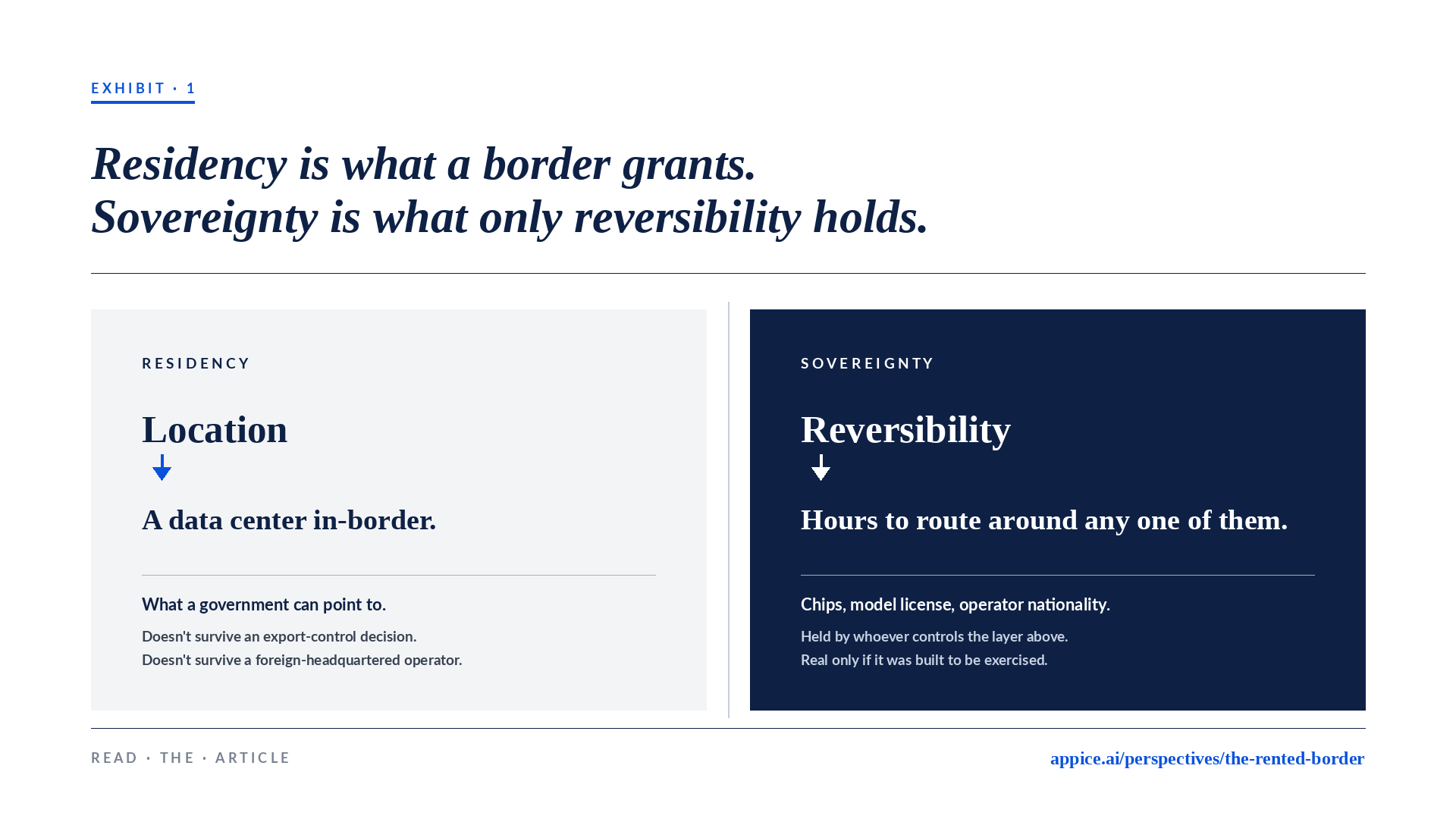
Data residency, the promise a government makes when it builds a data center at home, was never the same claim as sovereignty, the promise that no outside government decides what happens next. A 2026 academic review of 775 non-US data center projects found that US-headquartered companies operate 48 percent of them, weighted by investment value, a proxy for compute capacity. Building locally does not remove the operator's home government from the chain of command. It just relocates the building.
→ The architecture argument underneath this, in full: The On-Prem Awakening.
Europe has the same problem from the legal side rather than the physical one. The US CLOUD Act lets American authorities compel a US-incorporated cloud provider to hand over data it holds anywhere in the world, including inside an EU data center that never touched US soil. No contract signed in Brussels or Frankfurt voids it. The European Commission's own October 2025 Cloud Sovereignty Framework concedes the point without saying so directly: of its eight sovereignty categories, supply chain, meaning who owns the hardware and the code, carries the heaviest weight at twenty percent, ahead of data location. Brussels is now scoring cloud vendors on who built the stack, not on which country the servers happen to sit in.
India's version of the same exposure runs through Nvidia instead of a US cloud incorporation. The IndiaAI Mission has committed $1.25 billion to sovereign AI and trained two domestic large language models, Sarvam 30B and 105B. Every GPU running them is subject to US export control, the same mechanism that cut off China's chip access in 2022. Sovereignty built on someone else's chips is compute on loan, callable the way a Commerce Department order made Anthropic's models unreachable for 19 days in June: not because anything broke, because permission did.
→ The enterprise-level version of the same exposure, in full: 19 Days Dark.
A border decides where the data center sits. It has never decided who can turn it off.
What sovereignty spending is buying
It buys real things. Jobs, latency, a lower bill from not routing traffic across an ocean, and a genuine compliance answer for the regulators who only ask where the data lives. None of that is nothing, and the money behind it is real: Gartner estimates a nation building a full sovereign AI stack needs to commit at least 1 percent of GDP to the infrastructure by 2029, and predicts 35 percent of countries will be locked into region-specific AI platforms by 2027. Gartner named the broader move geopatriation, and Appice covered its enterprise version in The Open Architecture Illusion, jurisdictionally distinct infrastructure as a survival requirement, not an upgrade. But none of it answers the three questions that decided the UAE, Saudi Arabia and India's exposure this year: who controls the chips, whose license governs the model, and which government the operator answers to first. A data center inside a border settles none of the three.
What holds up
Not a bigger data center. A government or an enterprise that has priced this risk correctly asks a narrower question: if the chip export rule, the model license or the operator's home government changed its mind tomorrow, how long before we could keep running anyway? For the UAE this year, the honest answer was that it depended entirely on a decision made in Washington. For a bank or an enterprise asking the same question about its own AI vendor, the answer has to come from architecture built for exactly that day, infrastructure and decisioning logic an operator controls directly, with a tested path off any single provider measured in hours, not the years a sovereign fund spends building a data center.
Sovereign in the brochure and dependent in practice are not opposites. In 2026, they describe the same data center.
The full argument for reversible architecture, at the enterprise layer, is in The Perimeter.