Every bank has an AI pilot. Few have an AI bank.
The evidence is consistent across three independent sources. Capgemini's research on financial services, published in November 2025, found that about 10 percent of firms have deployed AI agents at scale, while roughly 80 percent remain at the ideation or pilot stage. Gartner expects more than 40 percent of agentic AI projects to be cancelled by the end of 2027, citing escalating cost, unclear business value and inadequate risk controls. McKinsey, in its study of the agentic opportunity, reports that around 90 percent of function-specific use cases are still stuck in pilot mode.
Three sources, three methods, one conclusion. Banks are not short of models or of ideas. They are short of the conditions under which a model can be trusted to act, and those conditions are built beneath the model, not inside it.
Why banks feel it most
A bank is not a greenfield. Core banking systems date back decades. Customer data lives in platforms designed for overnight batch processing. Cards, loans, deposits and service each grew their own stack, and each stack has its own owner, budget and release calendar.
In that setting the fastest route for any pilot team is a private extract of the data it needs. For a single pilot this is a rational choice. Repeated across a dozen teams, it produces a dozen versions of the customer and no one with the authority to say which is current. The cost does not appear in any pilot's business case. It appears later, when the second and third agents go live.
Four pilots, four versions of the customer
Consider a typical sequence. The service team pilots an assistant that explains declined payments. Collections pilots an agent that reminds customers before a due date. Fraud pilots one that triages alerts. Compliance pilots one that chases expiring KYC documents. Each performs well in its demonstration, because each was built to perform well in its demonstration.
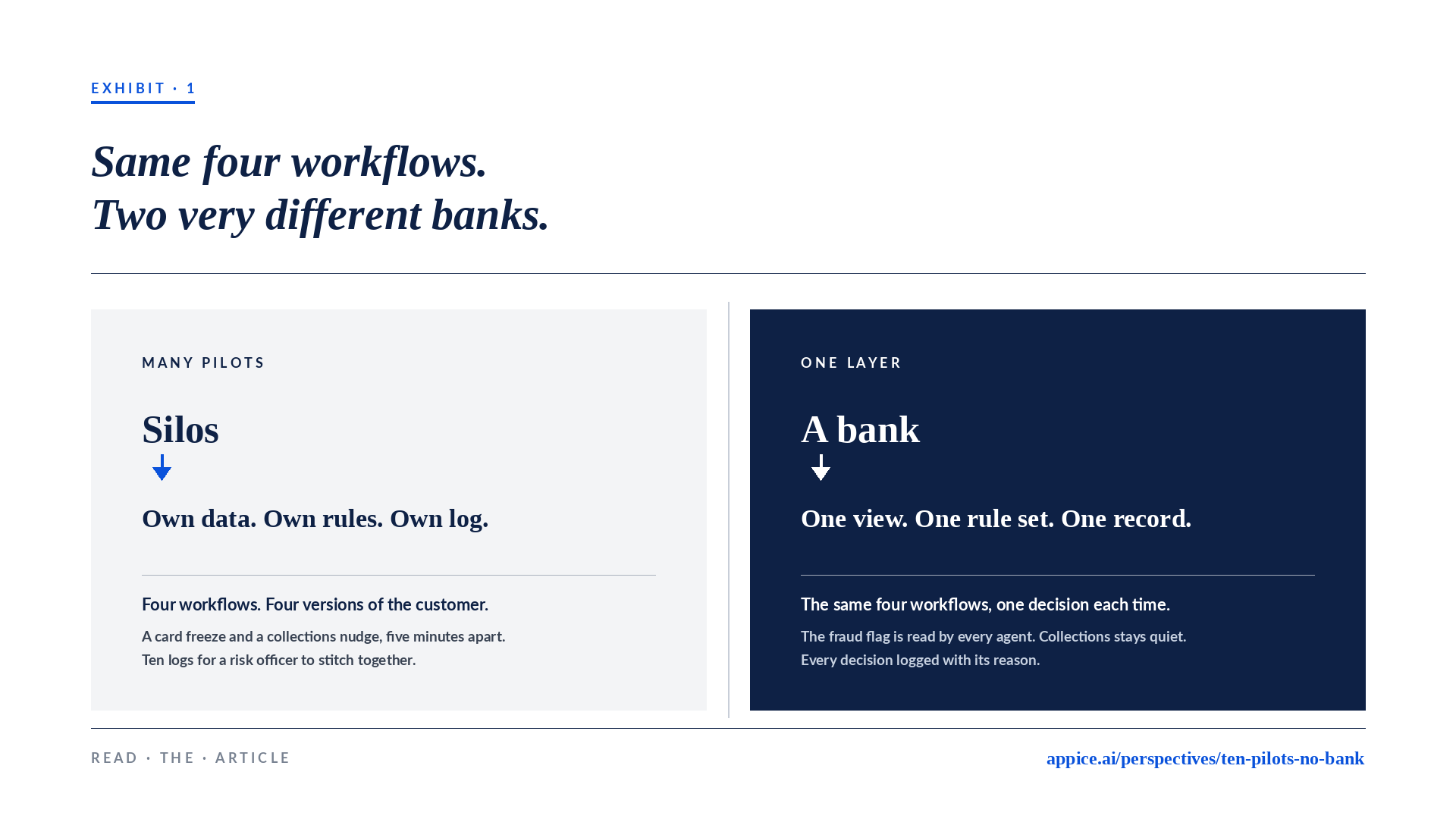
Each also arrives with its own copy of the customer data, its own rules on consent, quiet hours and tone, and its own log in its own format.
Then a customer's card is frozen at 9:00 a.m. and a collections reminder arrives at 9:05. Same customer, same hour, two agents that know nothing of each other. The customer does not see two pilots. The customer sees one bank contradicting itself.
Each agent did its job. The bank did not.
A pilot proves a task. It does not prove a bank.
A pilot answers a narrow question: can this model perform this task? The answer is usually yes. Production review asks a different question, and it belongs to the bank rather than the model. May this agent act on this customer, at this hour, under these rules, and can we show a regulator why afterwards?
No pilot is designed to answer that, so the project stalls at the gate. The agent has not failed. The institution has nothing beneath it that can give the required answer.
Supervisors are already asking. In February the Central Bank of the UAE issued a guidance note on the responsible adoption of AI and machine learning by licensed financial institutions. Its principles are governance and accountability, fairness, transparency, human oversight, and data management and privacy. Each describes a property of the bank's system as a whole, not of any single model. A bank with ten pilots has ten answers, and a supervisor will want one.
→ The same pressure from the other side of the table: The Regulator's Agent.
What fragmentation costs
The cost is easy to underestimate because it arrives in different budgets. Each new agent repeats the integration work of the last. Each needs its own consent and fairness review. Each adds another log that a risk officer must reconcile after an incident. The tenth agent therefore costs nearly as much as the first, when it should cost a fraction. That is the economic signature of an institution with pilots rather than a platform: scale brings no savings.
What sits underneath
The remedy is not a better pilot. It is a shared layer that every pilot should have had from the start, with three properties built once.
One view of the customer. Structured and unstructured data from core banking, CRM, streaming and third-party sources, given shared meaning, so that every agent reads the same customer in the same way.
One set of rules. Consent, contact limits, fairness and product rules, applied once and before any agent acts, rather than rebuilt for each agent in the hope that they agree.
One record. Every decision logged with its reason in a single place, rather than ten logs that a risk officer must stitch together after something goes wrong.
Return to the 9:00 a.m. freeze. With the shared layer, the fraud flag is a signal that every agent reads. Collections sees it and stays quiet. The service agent sees it and opens with an explanation instead of a payment prompt. One decision is made once, with the reason on the record.
An agent placed on top inherits all three properties. Humans keep what humans should keep: the exceptions, the hardship conversations and the final call.
Is this another platform to buy?
It is a fair question, and the answer is no. The layer does not replace the fraud engine, the collections system, the case tool or core banking. Those keep detecting and recording. The layer sits beside them, reads their signals, decides what should happen next and tells every system and person once. The bank keeps the systems it trusts and gains the one thing none of them provides: a shared decision.
Three questions for the next steering committee
Before approving another pilot, a bank's leadership can ask three questions. Which customer record will this agent read, and is it the same record the other agents read? Whose rules on consent and contact limits will it follow, and where are they enforced? Where will each of its decisions be recorded, and could a supervisor read that record without help from the project team?
A pilot that cannot answer all three is a demonstration, not a step towards production.
The layer already exists in one department
Marketing has been building it for a decade without calling it that. A signal comes in. A decision picks the next best action. A message goes out on the right channel. The response returns and the next decision improves. Consent is checked at every step.
That loop is the Action Layer: sense, decide, act, learn. At Appice it senses on a customer data platform, decides in under 200 milliseconds, acts across 14 channels and learns from what happens next. It runs inside the bank's own environment, on premises, cloud, hybrid or multi-cloud. Marketing runs on it in production today.
The next workflows are service, collections, fraud remediation and KYC refresh. Moving them does not require a new platform. It requires new rules on the same core, and a seat for AI agents beside the humans already working there.
A pilot proves an agent can do a task. A layer proves a bank can let it.
The banks that move beyond pilots will not do so with better models, since most banks rent the same ones. They will do so with one view of the customer, one set of rules and one record, and every agent they add will inherit all three.
The accountability question underneath all of this is in When the agent decides, who answers?
Sources
- Capgemini Research Institute, World Cloud Report in Financial Services 2026, press release, 12 November 2025. businesswire.com
- Gartner, Gartner Predicts Over 40% of Agentic AI Projects Will Be Canceled by End of 2027, press release, 25 June 2025. gartner.com
- McKinsey & Company (QuantumBlack), Seizing the agentic AI advantage, June 2025. The 90 percent figure covers function-specific use cases across industries. mckinsey.com
- Central Bank of the UAE, Guidance Note on Consumer Protection and Responsible Adoption and Use of AI and ML by Licensed Financial Institutions, 23 February 2026. centralbank.ae