One reform changed how hundreds of millions of people pay. Another is trying to change how twelve public sector banks behave. The first, UPI, is now being taken abroad. The second, EASE, is known mostly to bankers. Set side by side they share some ingredients and differ in important ways, and the differences are as instructive as the similarities. Potentially, EASE is assembling a second playbook.
What UPI actually was
UPI is credited with accelerating digital payments across India. In FY2025-26 it processed about 242 billion transactions worth ₹314 lakh crore. Its reach into the lives of street vendors and first-time account holders is well documented. Yet it was never only a piece of technology. Three things worked together.
The first was a mandate, in the sense of a clear government push. Demonetisation in 2016 sent people toward digital payments. Whether UPI would have succeeded without it is debatable, but its aftermath left a sense of what was possible. Low-value payments were later kept free for small merchants. No order named UPI; the push set the conditions. The second was mechanism: a neutral payments rail, the Aadhaar and mobile base, and the more than 400 million accounts opened under Jan Dhan. The third was a mindset, a shift in what merchants and customers considered normal.
One more feature matters for what follows. UPI was a joint project of public and private banks. NPCI's promoter banks included ICICI Bank and HDFC Bank alongside SBI, PNB and others, and once the rail was live it was open to every bank and, later, to fintech apps that competed hard for the same customers. Competition sat inside the system from the first day.
It took all three. Demonetisation arrived in 2016, but monthly UPI value stayed under ₹10,000 crore until December 2017, held back by the cost to merchants. The push was present. The pull took longer.
The model is now travelling. NPCI's international arm has reportedly signed agreements with the central banks of Peru and Namibia to help them build UPI-like systems, and the Prime Minister has described UPI as a template other countries can use. In February 2026, Nandan Nilekani put the obvious follow-on question in the subhead of a Financial Express op-ed:
“How India can do for AI adoption what UPI did for payments”Nandan Nilekani, Financial Express, February 16, 2026 (subhead)
The same question can be asked of the banks themselves.
A turnaround with several authors
RBI data reported in 2018 put the gross NPA ratio of state-owned banks above 14 percent. The government merged ten banks into four, which took the number of public sector banks from 27 to 12, and the banks worked through a common reform agenda that EASE carried forward each year. In FY26 they reported a record combined net profit of ₹1,98,210 crore, with gross NPAs below 2 percent, the lowest on record, and provision coverage above 90 percent.
EASE also began after a shock: the asset quality review had exposed the scale of bad loans, and the first edition followed the PSB Manthan meeting in 2017. It would be unwise to credit any one programme. Recoveries, recapitalisation, insolvency reform and a benign rate cycle all contributed. EASE's part was quieter and still useful: it gave twelve banks one agenda and one vocabulary, and it measured them against each other. At PSB Manthan in 2025, the Financial Services Secretary said public sector banks had moved beyond a phase of survival and stability. The regulator, speaking at the same event, added a caution:
“Periods of comfort … can create the risk of complacency”Swaminathan J, Deputy Governor, Reserve Bank of India, PSB Manthan, September 12, 2025
The caution applies to a programme as much as to a bank. A good year is not yet evidence that the method works, which is why it is worth asking where the behaviour change comes from.
Where the mindset comes from
Of the three levers, mindset is the hardest to engineer, and it is rarely produced by instruction. In banking it appears to come from three sources.
Competition. Private banks have been winning the everyday relationship. One report, citing industry data, has private banks' share of household deposits rising from 30 percent in FY20 to 35 percent in FY25, while public sector banks' share fell from 62 to 56 percent. The figures come from a single secondary source and should be treated with care, but the direction matches what customers say. An EY survey of 2,030 banking customers, published in May, found that 55 percent want better digital support across app, web and chatbot.
A scorecard. A public number invites comparison. Banks announce their position in the EASE index in press releases: Union Bank when it came second in EASE 5.0, Bank of Baroda as first runner-up in EASE 7.0, SBI when it topped a quarter. A bank that advertises a ranking has decided that the ranking matters.
Union Bank of India's account of its Q1 FY23 result shows how the scorecard is read. The bank said it had moved up two notches to second place, and it credited its digital journeys, analytics, collaborative banking, employee development and governance measures. It also said it had set the benchmark on two of the five EASE 5.0 themes. A bank's own account is not independent proof, but it shows the ranking being used as a list of things to do, and not only as a result to announce.
A peer group. Twelve banks work from the same agenda and meet in the same rooms. The index was designed partly to encourage banks to learn from one another, and the IBA's chief executive, Atul Kumar Goel, summarised the programme's effect in July 2025 as deeper MSME reach, faster generative-AI readiness and stronger data governance across the group. Whether banks actually copy what works from one another is hard to see from outside, and it is a fair question to put to the index.
Independent evidence on whether this works is thin and mostly supportive. A research report prepared for the Indian Institute of Banking and Finance compared public and private banks on CAMELS ratios and found that public sector banks improved on capital adequacy, management quality, earnings, liquidity and sensitivity after 2018, while private banks remained ahead. Its sentiment analysis of about 10,000 tweets found opinion more positive towards public than private banks, despite lower app ratings for the public banks, which the authors attributed partly to government ownership. The study describes the index's ranking and inter-bank comparison as designed to create competition among the banks. It does not isolate the index's own effect.
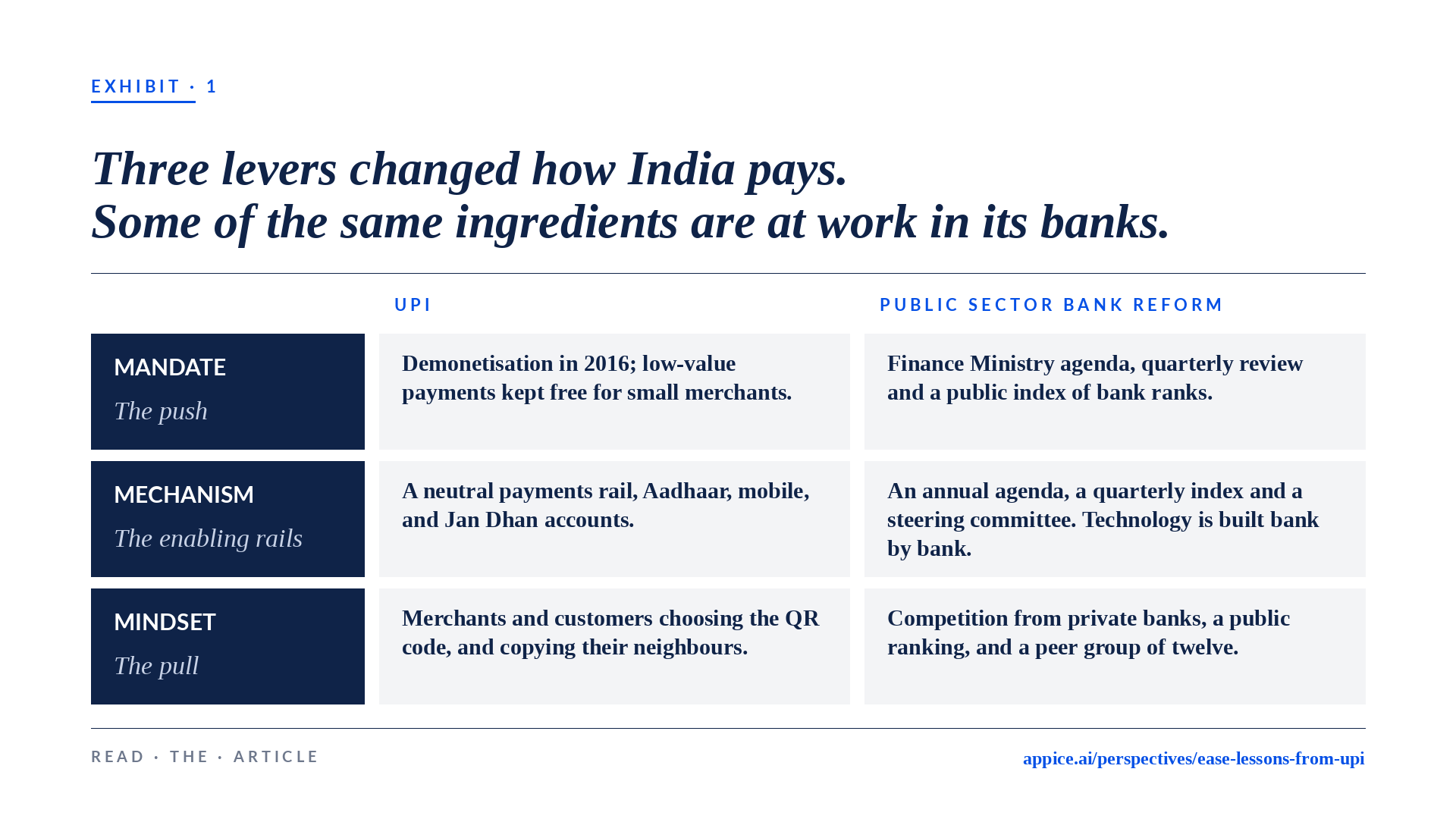
None of the three can be ordered. Together they are what turn a mandate into behaviour. UPI had them too: merchants competed for customers, the QR code was visible on every counter, and neighbours copied neighbours.
→ How banks can show their AI is working as intended: EASE 9.0: Showing the Work on AI.
Where the analogy bends
EASE differs from UPI in three important ways. First, it covers public sector banks only. The competitive pressure arrives from private banks that the scorecard does not measure, and the peer group is twelve institutions, not the whole industry.
Second, its mechanism is lighter. UPI gave every bank one neutral system to plug into. EASE offers an annual agenda, a quarterly index and a steering committee, but no shared systems: each bank builds its own capabilities, and the scorecard has to do work that a common rail did for payments. The AI themes in EASE 9.0, from core AI stacks to consent management, are where that gap will be felt first. That makes the comparison with private banks the number to watch.
Third, much of what EASE asks for is not technology at all: financial inclusion, credit for small businesses, governance, talent. Technology helps with each of them without doing them alone. Jan Dhan shows the interaction. A mandate and the mechanism delivered about 59 crore accounts, one of the largest inclusion efforts anywhere. The next question is use. Business Standard reported that 26 percent of public sector bank Jan Dhan accounts were inoperative at the end of September 2025. That is a gap in behaviour, and it is also the size of the opportunity. Technology can help by reaching the customer at the right moment, in the right language, with a reason to act. It cannot substitute for the customer's own decision to use the account, which is why mindset, and not mechanism, is the lever to watch.
Could the recipe travel?
It is already travelling at home. Asia Insurance Post reported in August 2026 that the government, "impressed" by what EASE had done for the banks, was preparing a similar agenda for the six public sector general insurers, and in October that DFS had appointed a head for the project implementation unit, Project Sankalp, engaged for three years. The report is cautious: the framework is proposed, and its value will depend on how quickly recommendations become measurable improvements. Even so, it is the first sign that the method can be lifted out of banking.
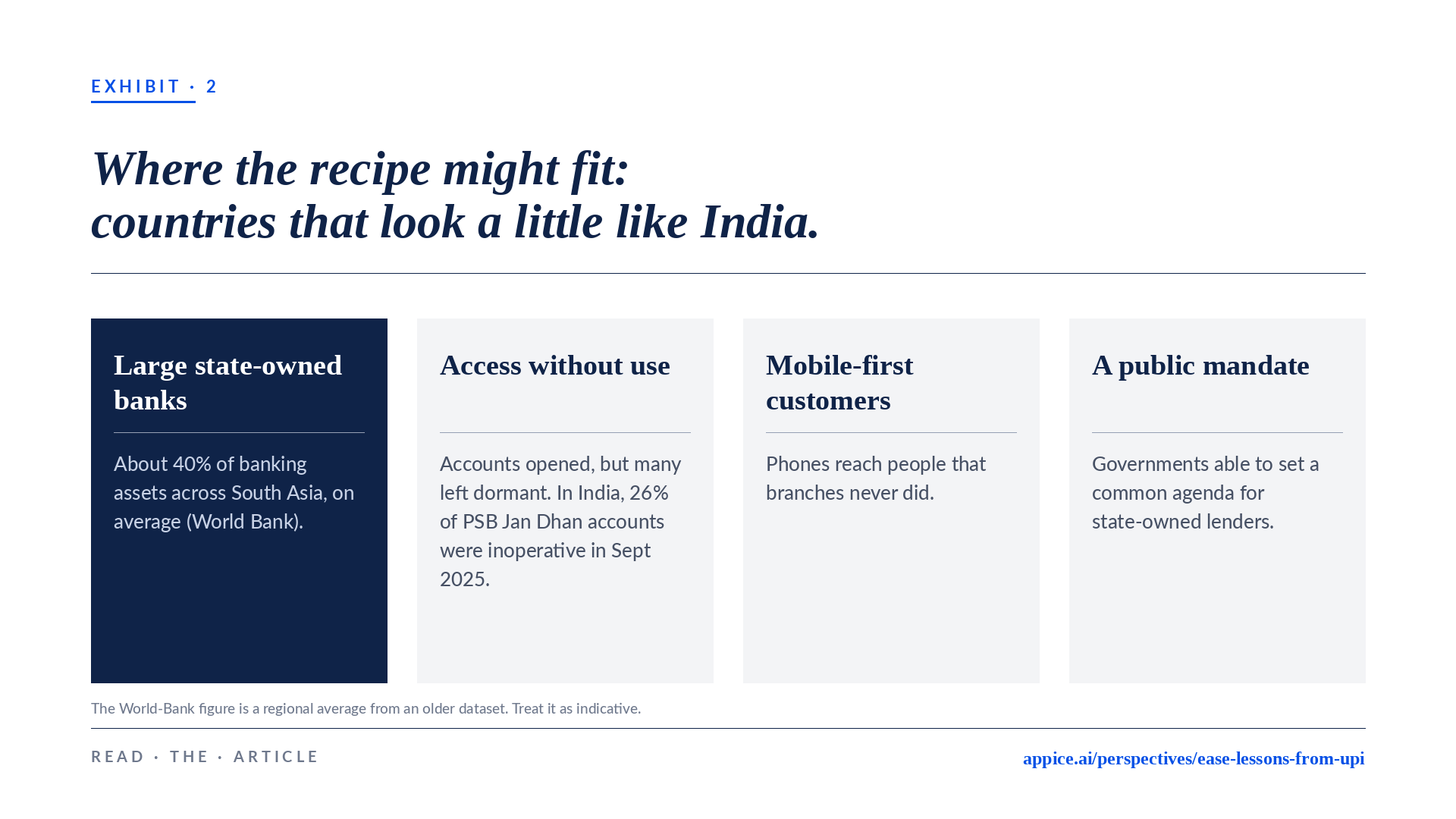
Abroad is a longer question, and worth asking. UPI shows that India can package a system and offer it to partner countries. Public sector bank reform might be packaged in a similar way, in due course, for countries that share some of India's characteristics. On a World Bank estimate, state-owned banks hold about 40 percent of banking assets across South Asia on average. Many such countries also have more accounts than active customers, populations that reach finance through a phone, and governments able to set a common agenda for state-owned lenders. A programme designed for that situation may fit them better than a payments rail designed for an open market.
The package would probably have three parts: the measurement design, a common agenda with a bank-specific roadmap and a public index; shared capability patterns, such as common standards for consent and AI decision records; and the change method, meaning how to build the competition, scorecard and peer group that make a mandate stick. The useful question is where the technology sits in that package, and which parts of it are not technology at all.
→ What a shared standard for bank AI could look like: A Shared Rail for EASE's AI Agenda.
The test ahead
UPI's lesson is that a mandate, a mechanism and a mindset have to arrive together, and that the mindset is the slowest to come. EASE has a mandate, a lighter version of a mechanism, and a mindset still being formed. Three tests will show how far it gets.
The first is whether the index begins to measure what customers experience, and not only what banks report. Today's ranks are overall scores, and the most convincing proof will be customers saying their bank has improved. The second is whether banks learn visibly from one another, so that a good idea at one becomes a standard at all twelve. The third is whether the insurers' programme shows that the method can be lifted out of banking without losing what made it work.
None of these is certain. All can be seen from outside, which is what makes them fair tests, and the people assembling the pieces, at the Finance Ministry, the IBA and the banks, are doing it in public and with a scorecard.
UPI exported a system. EASE may yet export a method.
Working with Appice on EASE. How Appice works with public sector banks on EASE 9.0, and where it does not. Read more.