India's twelve public sector banks hold more than half of the country's banking business, and since 2018 they have been measured against a single annual reform agenda. It is called EASE, it is widely discussed and rarely explained. This is a plain guide to what it is, who runs it, how it is scored and what the ninth edition asks of banks.
What is EASE, and where did it come from?
EASE grew out of PSB Manthan, a gathering of public sector bank leaders in November 2017, at a time when state-owned banks were working through heavy bad loans. The Department of Financial Services launched the first edition in 2018 around six themes: prudent lending, better customer service, wider credit access, stronger governance and related areas. From the start it came with a way of keeping score. The IBA brought in the Boston Consulting Group to design an index that would measure each bank objectively on its progress, using about 140 metrics in the first year.
Since then a new edition has followed roughly each financial year. EASE 4.0 in 2021 was framed around clean and smart banking. EASE 5.0, in June 2022, paired a common agenda with a three-year roadmap specific to each bank. By EASE 7.0, whose annual report was released in July 2025, the language had shifted toward what that report called a strong customer-first approach. For the turnaround story in detail, from the ₹85,371 crore loss in FY18 to the record profit of FY25 and the awards by edition through EASE 8.0, see India fixed its banks, an earlier piece in A Moment to Think.
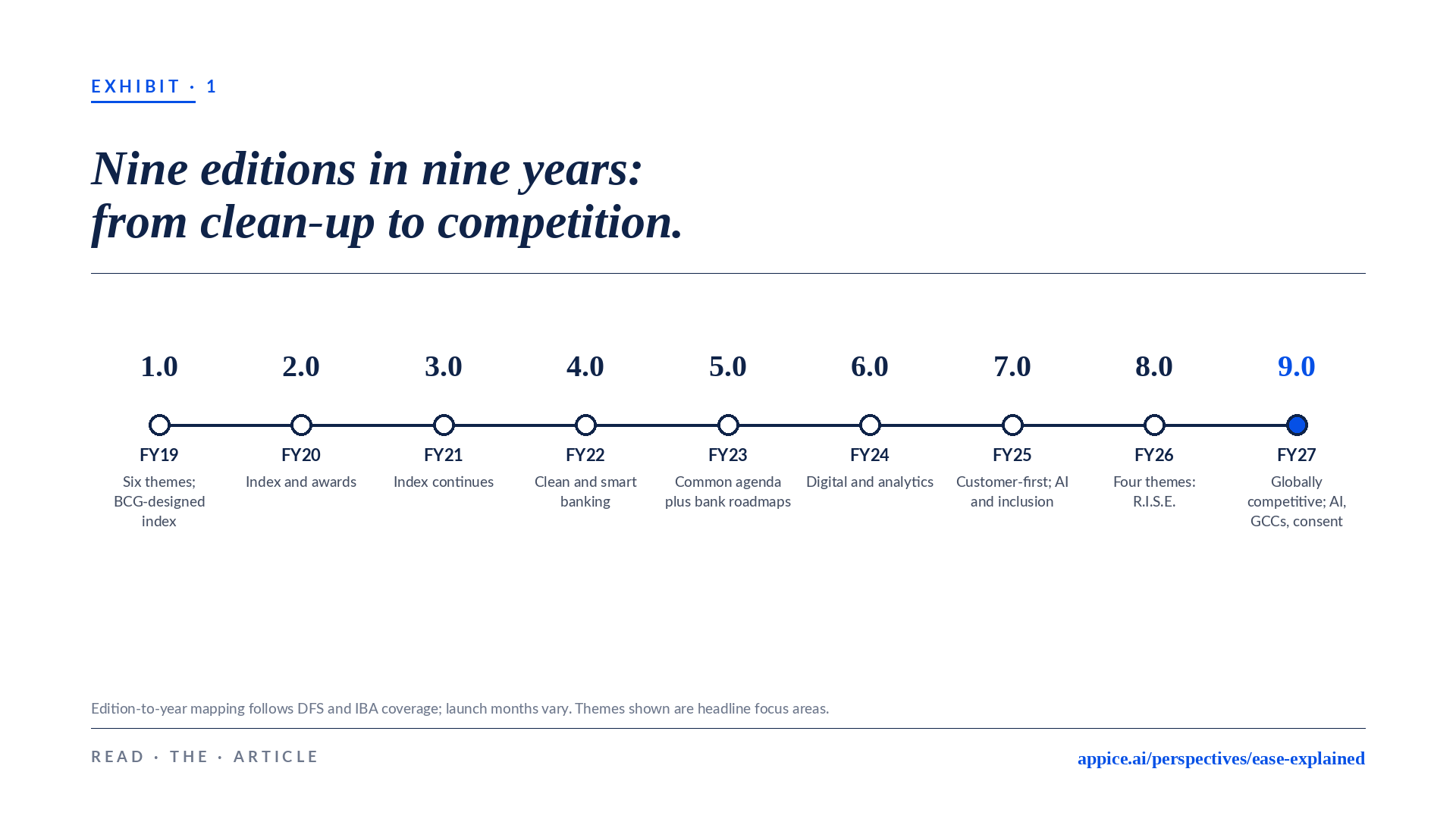
The logic of the design is worth stating plainly. State-owned banks do not face the same market discipline as listed private rivals, so the programme tries to supply a substitute: a published agenda, a shared yardstick and a regular reckoning. Editions have also grown more ambitious as the basics were secured. Early rounds concentrated on asset quality and governance. Later ones moved to customer service, technology adoption and, now, global competitiveness. Each edition builds on the one before, which is why the nine are best read as a single arc rather than nine separate programmes.
Who runs it?
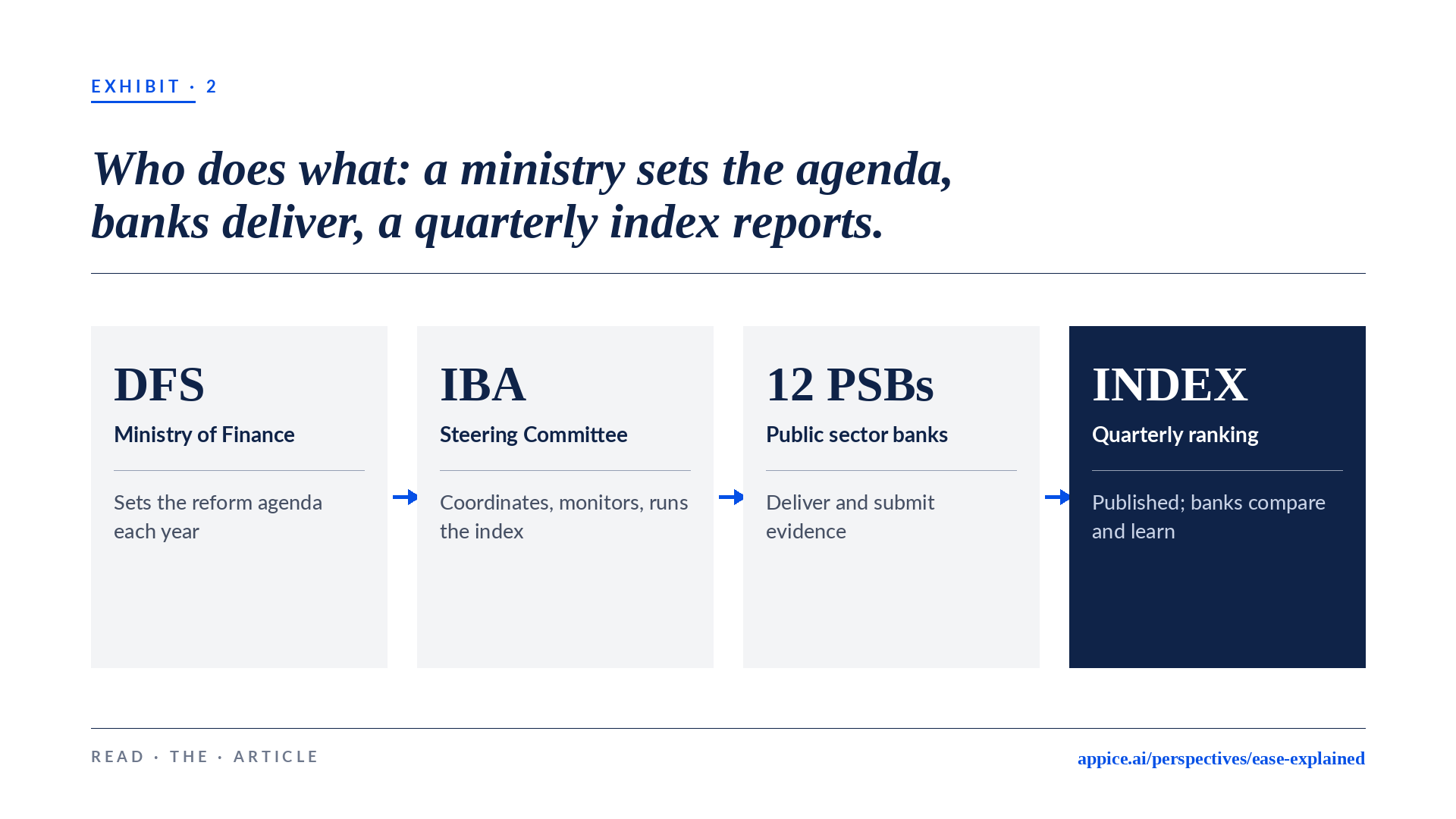
Three parties share the work. The Department of Financial Services, part of the Ministry of Finance, sets the reform agenda. The Indian Banks' Association coordinates it, and an EASE Steering Committee of senior executives from the public sector banks monitors design and delivery. The banks themselves do the work and submit the evidence. Results are reported quarterly in an index, and there are annual awards and an annual report.
How does the index work?
The index scores each bank against the year's agenda and ranks the banks relative to one another. Scores are relative: when the Q1 FY23 index was reported, the average score moved from 38.6 to 37.7 out of 100, a reminder that the number measures standing within the group, not progress against an absolute standard. The number of metrics has varied by edition, from about 140 at the start to 107 in the second edition and more than 120 in later descriptions. The methodology is shared with the banks, although the weights are not publicly detailed.
Rankings are visible. Union Bank of India announced its second place in EASE 5.0, Bank of Baroda was first runner-up in EASE 7.0, and SBI topped the Q1 FY23 index. That visibility is part of the design. A public ranking invites comparison, and comparison is one of the ways a reform programme changes behaviour.
What does EASE 9.0 ask for?
Edition 9.0 was launched in February 2026 by the DFS Secretary, M. Nagaraju. Its four pillars carry forward the R.I.S.E. structure introduced with EASE 8.0, branded EASERise: Risk and Resilience, Innovation, Socio-economic Impact, and Excellence. Within them sit sixteen themes. The innovation pillar names AI explicitly, including generative and agentic AI.
“Globally Competitive Public Sector Banks for Viksit Bharat@2047”Theme of the EASE 9.0 reforms agenda, unveiled by DFS Secretary M. Nagaraju, February 2026, as reported by Hellobanker
Several of the specific asks read as infrastructure rather than strategy. Public sector banks are to implement a global capability centre strategy in FY27, with SBI in the lead after setting up the first such centre among state-run lenders. They are to develop core AI stacks, including LLM licensing, GPU strategy and private cloud, assess active-active data centres for resilience, build enterprise-wide consent management, and apply tokenisation and anonymisation at scale. Socio-economic themes cover inclusive banking and financial access for underserved groups, including gig and platform workers.
→ What the AI asks mean in practice: EASE 9.0: Showing the Work on AI.
Is EASE the same as RBI regulation?
No, and the two are often confused. The Reserve Bank of India regulates and supervises banks, and its FREE-AI framework, published in August 2025, sets expectations for how AI is used in every regulated financial institution. EASE is a reform programme run by the Finance Ministry for the public sector banks it owns. It is not a legal obligation in the way a regulation is. Its force comes from ownership, from the quarterly index and from the public comparison between banks. A bank can meet RBI rules and still rank low on EASE, or the reverse, because they ask different questions.
What has EASE changed?
Attributing outcomes to a single programme is difficult. In FY26 public sector banks reported a record combined net profit of ₹1,98,210 crore, with gross NPAs below 2 percent, the lowest on record, against more than 14 percent reported in 2018. Recoveries, recapitalisation, mergers that cut the number of banks from 27 to 12, insolvency reform and a benign rate cycle all contributed. EASE's contribution was to give twelve banks a common agenda and a common vocabulary, and to measure them against each other.
The IBA's chief executive, Atul Kumar Goel, summarised the programme's effect in July 2025 as deeper MSME outreach, stronger sectoral capabilities and better credit access, with banks also accelerating generative-AI readiness, strengthening data governance and moving to cloud. What the programme has not yet published, in the sources reviewed here, is independent evidence on customer satisfaction, which is where the next edition's credibility will be tested.
Why does it matter beyond the banks?
Public sector banks are the main route to finance for much of India. A programme that raises their standard of service and risk management touches small businesses, first-time borrowers and the millions of people who opened accounts under Jan Dhan. It also matters as a design: a common agenda, a public index and a peer group of twelve banks is a method that other countries with large state-owned banking sectors may eventually find useful. It could also provide a stimulus for other public sector organisations in India to raise their own standards of service and performance, and that is beginning to happen. Asia Insurance Post reported in October 2026 that DFS had appointed a head for Project Sankalp, an EASE-style reform programme for the six public sector general insurers, which the report described as a shift towards measurable performance and technology-led change.
→ The lessons from India's most successful financial reform: What UPI Can Teach EASE.
What to watch next
Three things will show where EASE goes from here. Whether the index begins to include customer-outcome measures alongside the hygiene ones. How the AI themes are evidenced, since the choice between system-generated logs and prepared submissions will shape what banks build. And whether the lessons of early movers are shared as patterns for the rest, rather than staying inside individual banks.
→ How shared standards could help: A Shared Rail for EASE's AI Agenda.
EASE does not tell a bank what to be. It tells twelve banks where they stand.
Working with Appice on EASE. How Appice works with public sector banks on EASE 9.0, and where it does not. Read more.