Context is having a moment, and not because of one report. Gartner is telling technology leaders that context engineering, not prompt engineering, is what separates a working AI agent from an expensive demo. MIT Technology Review has spent much of 2026 tracking how well an agent grasps a business's own context, finding that grasp is what actually predicts whether it can be trusted with a real decision. BCG's research into AI-first enterprises names context, not compute, as the likely ceiling on how far agentic systems can scale. Context, like every generation of customer data technology before it, only creates value at the moment something decides. Storage doesn't count. Deciding does.
One of those accounts gave the idea its sharpest name yet. State of Martech 2026, Scott Brinker and Frans Riemersma's account of the marketing technology industry, maps three ingredients: Company Context, what a business knows about its own strategy and constraints, Customer Context, what it knows about the people it serves, and Systems Context, whether any of that knowledge can reach a channel in time to matter. Where all three overlap, they call it Golden Context, a deliberate echo of "golden record," the decades-old promise of one authoritative customer view. "A brilliant customer insight sitting untouched in a data warehouse is not an asset," they write. "It's inventory that's spoiling."
→ The six-generation chase that golden context is echoing: The challenges of getting to a golden record.
Two jobs for the same context
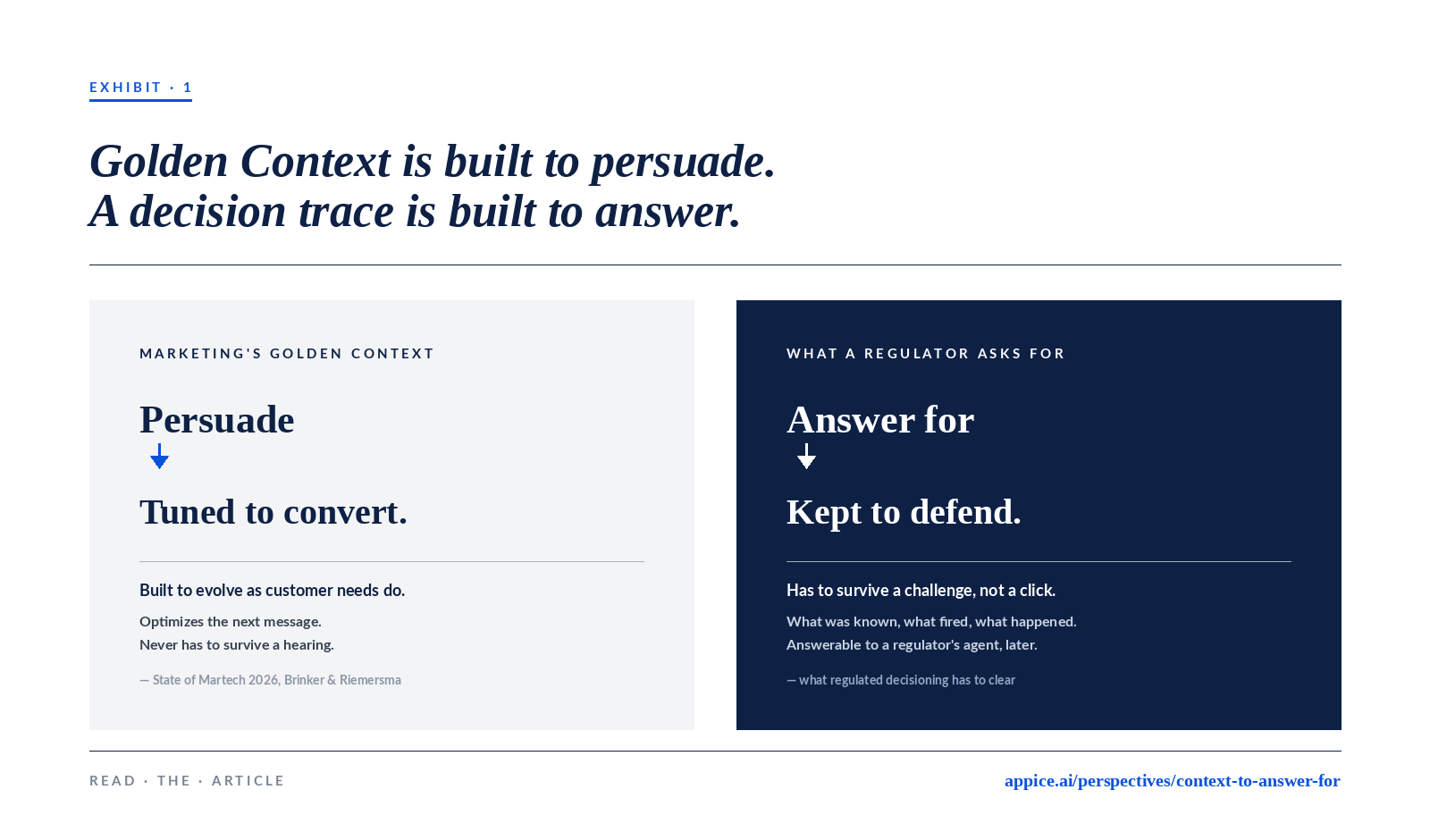
Golden Context is a genuine advance, three real signals brought together to make the next message sharper. But knowing what convinced someone and being able to explain how that conviction was reached are two different things, and only one of them holds up when someone asks for it later. Context built to persuade and context built to answer for are not the same thing, even when they're built from identical ingredients. A context that keeps evolving to match what a customer wants next is tuned for one job: it gets better at predicting the next message, the next offer, the next click. It was never built to answer a harder question afterward, whether the decision it produced can be reconstructed and defended, to someone who wasn't in the room, doesn't care how well it converted, and has the authority to ask anyway.
Marketing needs context to decide what to say next. A bank needs context to prove what it did, and why, months after the moment that produced it is gone.
The same three ingredients, a different job
Appice's own loop, sense, decide, act, learn, runs through the identical three ingredients: company policy standing in for Company Context, live customer signal standing in for Customer Context, and reach across channels standing in for Systems Context. That overlap isn't a coincidence. Any serious account of context ends up describing the same underlying problem, what does a business know, about itself and about the person in front of it, and can it act on that knowledge before the moment closes.
The output is where the two diverge. A marketing platform's job is to convert that knowledge into the best next message. What banks, telcos, and insurers operating under RBI, SAMA, MAS, and GDPR need instead, and what Appice is built toward, is that knowledge converted into a decision trace: what was known, which policy fired, what happened, kept in a form a regulator's agent or an internal auditor can still ask about long after the moment that produced it has passed. Context that only has to survive a click doesn't need that record. Context that has to survive a hearing does.
That record has to be built in real time, inside the same window as the decision itself, not reconstructed afterward from logs that were never meant to answer this question.
A record assembled after someone has already asked reads like an alibi. A record built into the decision from the start reads like evidence.
Picture a loan declined on a Tuesday in March. The decision used a live read of the applicant's transaction history, a company policy on debt-to-income ratios, and a system check confirming that policy applied to this specific product, company policy, live signal, and system reach, each doing its job. Six months later, the applicant complains to a regulator. Nobody's asking what the bank could have offered this person instead. They're asking what it knew, which policy fired, and whether that was the right policy to fire. A decision trace answers that on the spot. Anything less has to be pieced back together, and a reconstruction rarely holds up as cleanly as the original record would have.
→ What that record actually has to hold up to: The Regulator's Agent.
Appice was born in the smartphone era on a bet about context awareness, the belief that a smartphone experience had to be aware of the moment, in real time, to mean anything. That bet turned out to be half the answer. Delivering Appice inside banks made the other half impossible to ignore: being able to explain what the system knew and why it acted was never optional once real money and real regulators were involved. Context is having its moment again, this time for AI agents. The word for what happens after a decision, when someone asks you to prove it, still needs writing.
The full report deserves a read on its own: State of Martech 2026, by Scott Brinker and Frans Riemersma. The longer argument on why the customer record kept arriving late is in A Moment to Think.